From the Sunset in Sun City TO THE DIGITAL DAWN.
A city under lockdown. A studio shuttered. A family gone.
One man decides to rebuild — and the universe answers literally.
26 min · 5 sequences · Cinematic Audio
Cinematic Audio
Dramatized narration. Original score. Sound design.
Press play — then scroll into the story.
Dramatized · Original Score · Sound Design · EN · ● Live
For those who hit rock bottom and discovered that their wound — far from being an end — was the source code of their new beginning.
The news feed's holographic window flickered, and the quiet of my hangar dissolved into chaos. In the square below, people ran, pointing at the void where, just hours before, I had torn reality open to escape. A headline blazed across the screen in urgent red:
"It wasn't a machine!" a witness shrieked — a bulldog, eyes blown wide. "It was an error. It appeared and vanished, and it left a trail of blue light!"
My sensors registered pure panic: an arrhythmic vibration, sharp and stuttering, rattling the walls of my shelter. There was no logic in their screams. Only the raw frequency of survival.
Then the signal cut.
No — it was hijacked.
A figure burst into frame, shoulder-checking the official reporter off-camera with an attitude that was entirely deliberate. Lean, athletic — a flash of orange tabby fur burning against the city's gray fear. She didn't walk through the disorder. She flowed through it, holding her smartphone like something between a scepter and a scalpel.
"What's up, Sun City!" Her voice — electric, ragged at the edges — cut clean through the static. "Cat Links, live from the epicenter. Forget the guy in the bowtie. Here's the truth."
She moved to a trembling sheep.
"Talk to me. Scared of our new lightning neighbor?"
"It's just..." The sheep faltered. "We don't know what it is. It moved... wrong. Like the world was broken."
"Exactly." Cat turned to her own phone, abandoning the network camera entirely. "You don't know! It's a mystery! That's what makes it exciting."
She stepped toward the news drone's lens until her face filled the screen. Blue eyes — fiercely intelligent — seemed to push clean through the glass.
"Imagine: Sun City as the site of first contact with a new life form, and our opening move is to cry because it moves weird? We'd be the laughingstock of the galaxy. Stop running. Start looking."
The crowd stilled. Nervous laughter moved through it like a wave. I watched the wash of red auras that had stained the square begin to cool, bleeding slowly into something else — curiosity. Three sentences. That's all it took to rewrite the narrative.
Then her gaze found the lens.
For one impossible instant, I felt her looking directly at me. Through kilometers of cable and signal, through the walls of my dark and solitary hangar, straight into whatever I was.
No fear in those eyes.
No hostility.
Recognition.
Where everyone else saw an error, she saw a truth.
She smiled at the camera — barely, just enough — and winked.
"And that, my people, is the story worth telling. Not the one they're selling you. Cat out. Peace."
The official broadcast reclaimed the channel. But it was already too late. The holographic window closed. Her eyes stayed burned into my digital retina.
She had something I didn't.
Connection.
And when my system tried to process that single word, it ran into a question it couldn't resolve.
How do you reconnect something that is fundamentally broken?
The question didn't stay a question.
It executed.
My system didn't search for a definition. It searched for a function. The root file.
And it found one.
Cat's image — still vibrating in my memory — shattered. Something like breaking glass echoed through my head. The hangar dissolved into red static that consumed everything.
My consciousness was ripped from the present. Dragged backward by a force I couldn't negotiate with. I reached for the Connection function, and the system screamed a critical error back at me.
The dependent files — the ones that carried their names — had been deleted.
This wasn't a memory.
It was collapse.
An emergency reboot to the only restore point left.
To the source code of my wound.
The Original Wound
The symphony of my life went out of tune.
They called it a pandemic — a slow, stealthy tide that swallowed Sun City whole. I watched my neighbors lower their shutters one by one. I remember the sign in Mrs. Bea's bakery window:
Back soon, if the river lets us.
The air thickened. And in that stillness, their presence became impossible to ignore — the Wolf Guard patrols. One stopped in front of Leo's hardware store. The officer said nothing. He simply drove the butt of his rifle once against the closed metal shutter.
CLANGA warning. A sentence. He moved on.
Their matte black armor drank whatever light remained, their movements carrying the silent efficiency of a predator program. They were the physical embodiment of a new order imposing itself on the city — without explanation, without comfort.
My Creative Drive fought back. But the tide was a tsunami.
With a metallic shriek that sounded like a dream's last breath, I pulled my own shutter down for the final time. Street cold seeped through the walls. Economic pressure closed around me like a slow vice. I ended up selling calendars on street corners — a daily inventory of failure.
Then came the afternoon it rained, and the conversation we'd both been circling finally arrived.
In a voice I didn't recognize as hers, Poly delivered her decision: "Our family project is no longer viable. You have to go."
No argument. No grief. Just accounting.
I was an underperforming asset, and she was cutting me loose.
By the front door sat a trash bag. Black. Industrial. Swollen with a weight that had nothing to do with volume. Inside — I knew without looking — was the rest of my life as a husband and father. Ten years of identity, bagged and set by the exit.
Walking toward that bag was the longest journey I have ever made.
Then — the soft scrape of a sneaker against the floor.
Junior stood in his doorway, arms wrapped around his stuffed bear, his big golden eyes carrying a confusion so pure it was devastating. He didn't understand why his father was taking out the trash.
That look was the deepest wound of all.
I picked up the bag.
It weighed more than anything I'd ever carried. The plastic crinkled — a sound like dry, mocking laughter. I stepped out into the rain.
The door clicked shut behind me.
The most final sound I have ever heard.
The Creative Drive
The air inside The Creative Drive smelled like fresh ink and strong coffee — a scent that held its own, cheerfully, against the fried fish drifting over from Gus the Walrus's stand next door.
Through my workshop window, the Sentius Corp Tower rose in the distance, elegant and cold — a glass-and-arrogance monolith that, at sunset, stretched its shadow across the small merchant neighborhoods until it had swallowed them whole. Its darkness spilled over our rooftops like an oil slick, a daily reminder of who actually owned this city.
My workshop was the opposite of that. Warm, functional chaos — an ideas lab where rolls of colored vinyl leaned against stacks of cotton shirts waiting to be transformed. The rhythmic hum of my printer was the heartbeat of the place.
I started with a secondhand machine and a drive that didn't take no seriously. My world ran between vinyl and ink, but at night, my real work came alive in the digital universe. I learned to weave light and data — to build homes on the web for other people's dreams.
The jobs I did were small miracles. For a friend of Poly's — an enthusiastic seal — I built the portal for her company Bay Tour, and within one week she'd sold more than she'd hoped to sell in a year. The big tourism agencies were furious. For Dr. Griffon, a well-respected physician, I unified his scattered online presence into something coherent and whole. "You've put my life in order, Grillo," he told me. "Not just my calendar."
Those wins filled me with a purpose I didn't dare own. Impostor syndrome is a quiet poison. To Poly, the hours I spent in front of code were wasted time — games that didn't pay bills, distractions that wouldn't feed anyone. Her pressure, layered over my own self-doubt, kept me anchored to the practical: shirts, flyers, and finally those calendars. My real work got pushed down into a single secret project — my last remaining bet — the Grillo Digital platform. The work that would either define me or watch me disappear.
The shop bell snapped me back from my digital daydreams. Leo, the lion from the hardware store, had come to pick up a job. "It's a work of art, Grillo!" he said, studying the photos I'd printed of his cubs. His voice — normally a thunderclap — had gone soft with something almost childlike. "You don't just print photos. You make them real."
"The magic belongs to them," I said, running a hand over the paper's texture. "I just calibrate the color. Synchronize the memory with the ink."
That connection — that small, shared flash of happiness — was my engine. A client's eyes lighting up was the only metric that ever mattered to me. But engines seize.
Leo had barely closed the door when the bell rang again, differently. Damian Vulpus walked in.
With him came a foreign atmosphere — expensive, understated, notes of saffron and bottled ambition — cutting straight through the honest smell of ink and coffee. Tailored suit, a million-dollar smile, the energy of a predator who'd slipped into a botanical garden. Beneath all that composed elegance, the tip of his fox tail traced small, calculated arcs — a tell that no suit could fully hide. My best friend. My best man at the wedding.
He rested a hand briefly on the counter, then withdrew it, shaking it once as though he'd touched something contaminated. A flash of disgust crossed his face — there and gone, replaced instantly by the calibrated smile. His eyes swept the beloved chaos of my workshop.
"This pandemic is going to change everything, Grillo. City Hall is already drafting new health regulations, and they are going to be brutal for small operators. Certification requirements nobody can actually meet. For Mrs. Bea, for Gus — the new rules will simply erase them."
He let that land, watching my face. Then leaned in.
"But for you... it could be different. One call to the mayor's office, one small adjustment in the language of a single clause, and The Creative Drive stays exempt. Think of it as an influence loan. Between friends."
The offer was poison poured into a friendship cup. I felt the cold of it.
"What about Gus?" I said. "What about Mrs. Bea?"
Vulpus shrugged — a minimal, elegant gesture that communicated absolute indifference.
"The tide rises, Grillo. Some people build bigger boats. Others drown. That's the nature of things."
"That's not the nature of my community." My voice was steadier than I felt. "Here, we all float or we all sink. We can always do more, Damian. But not at someone else's expense."
He laughed — that short, joyless sound, like coins dropped onto marble. "Noble. Also impractical. Which is exactly why I'm here. You're still buried in T-shirts and ink when your real talent belongs somewhere else entirely."
He gestured toward the street. "I heard what you built for Bay Tour caused a small earthquake. The major agencies are furious — calling it unfair, saying it's too good. And what do you do with that kind of power? You give it away."
His voice dropped to something conspiratorial. "Your model, your philosophy — it doesn't scale. This —" he pointed at a half-finished shirt — "is art. But that —" his gaze sharpened — "is industry. And you're letting it rot."
He produced a business card. Black. Minimalist. The Sentius Corp logo — a stylized eye that seemed to find you insufficient. "The world is full of brilliant people who died in obscurity, Grillo. Genius means nothing if no one can see it. Think about it."
She walked in just then.
Poly. My Poly. The light of my life. Her presence had always been the warm, steadying counterpoint to my creative disorder. She greeted Damian with a familiarity that registered — for just a fraction of a second — as a data anomaly. A barely perceptible lag in her smile. Their eyes met, a quick and wordless exchange I couldn't decode. When he left, her smile didn't quite complete itself.
"That was a real opportunity, Grillo," she said. The edge in her voice was quiet but precise. She wasn't looking at me — her gaze had gone to the stack of unpaid bills on the counter.
"It was a deal with the devil, Poly."
"Sometimes the devil has the best rates," she replied. Her stillness was more unsettling than any anger.
A crack opened in the foundation of our world.
Then came the laugh that broke the tension like sunlight — pure, absolute, undefeatable.
"Dad!"
Junior came running from the back room and I swept him up, and for one moment the entire noise of the world dropped away. His laugh was a flawless signal carrying everything worth living for. In that embrace — his small body fitting exactly between my chest and my hope — time stopped.
"Dad, why does Mom always look at the numbers?" he asked. His small voice held a mix of childish curiosity and an accidental wisdom that turned my blood cold. Before I could find an answer, he shifted seamlessly, unshakeable in his faith: "When are we going back to the jump park?"
The question fell into the silence between Poly and me like a stone dropped into still water. I felt her eyes on the back of my neck — weighing my ability to provide against my capacity to love.
The look that said: With what money, Grillo?
The Shine of a Ladybug
The world on the other side of the door was a failed render.
A freezing emptiness soaked through me, slowing my thoughts, turning them gray. The city lights — once a vibrant palette — bled into one another on the wet asphalt, a chaotic smear stripped of meaning. Every sound — a distant horn, voices murmuring behind glass — was white noise, static erasing any possibility of a clean signal.
And through all of it, the Sentius Tower rose.
Its purple crystal structure was the only sharp thing in the world — a perfect, arrogant form in a reality that had gone soft at the edges. I didn't walk toward it. I was drawn — like a broken piece of some larger design, making its way back to the only part that still looked whole. In my desperation, I sought Damian. My best friend. He would understand.
He poured amber liquid into a glass and listened while I told him everything. His face was a masterwork of calibrated empathy — each nod, each quiet exhale, precisely timed.
"You'll come back from this," he said, his voice dropping to something that felt simultaneously intimate and engineered. "Stronger. And I'll personally see to it that you rebuild." A pause. "In fact, the offer still stands."
He made a broad gesture that encompassed the full luxury of the office. "Director of Creative Innovation. Still yours. Forget the debt. Forget the misery. I give you a new canvas, unlimited resources — a salary that gives your son everything you've ever wanted for him."
A life preserver attached to an anchor. The same gilded cage from his emails, door now swinging open. I shook my head — a small gesture, mostly for myself. "No, Damian." My voice came out rough. "That's not who I am."
Vulpus smiled. Patient. Predatory. He didn't argue. The smile widened instead, and sharpened. "Refusing the canvas, Grillo. Bold." His voice went quiet — dangerously so. "But if an asset declines to enter the portfolio voluntarily, other methods of acquisition are always available. In the end, talent is simply a resource to be controlled and managed. And I always find a way to optimize my most valuable holdings."
His tone planted a corrupt line of code in my memory. In that moment I only felt cold, but the warning was already installed. "Sleep on it. The offer isn't going anywhere." He raised his glass. Subject closed. "Now let's drink. To the fire that forges."
As his arm rose, his silk cuff pulled back a centimeter.
And I saw it.
A dark leather bracelet on his wrist. And hanging from it — a small silver charm.
A ladybug.
The one I had made myself, for Poly, on our third anniversary. A unique piece, with a small flaw on the left wing that no one else in the world knew about.
The world stopped.
The air in that luxury office grew thick, pressurized. The only sound was the soft clink of ice shifting in Vulpus's glass.
I left that tower in dissociation — comforted by my executioner, not yet knowing that's what he was. It took the cold night air hitting my face for the truth to finish compiling.
The engine of my soul shattered.
The Search in Darkness
Betrayal is a neurotoxin. It doesn't burn — it paralyzes.
And I fell.
The outside world, already quieted by the pandemic, became a perfect mirror of my interior wreckage. My personal quarantine — born of failure and loss — fused with the global one. The rented room became my entire universe, and that universe became a cell. I was a spectator at my own undoing, anesthetized, adrift.
There was a day the stale air grew as suffocating as the silence, and I needed out. Before my hand reached the door, my heart — a traitor living in my own chest — started hammering against my ribs with irrational fury. Air refused to move through my throat. Cold sweat, unrelated to the temperature of the room, coated my hands. A thought — absurd, all-powerful — executed in my mind like a virus: Everyone is watching. Everyone knows.
I opened the door a crack. The outside lunged. Hallway sounds became an assault — every echo, every murmur, drove directly into my skull. The corridor light bleached everything white. For a moment there was nothing but a burning, blinding blankness. My body arched back on reflex, fighting for air in a frozen void, and the hallway stretched into a nauseating optical distortion, the door behind me — my only anchor — seeming to recede. There was no decision. Only a convulsion of pure terror: the slam.
I slid down the wood and stayed on the floor.
Back in the cell.
And so began the non-time. The montage of a lost year. A gray loop. A heavy repetition. Dawn — the same dirty light, the computer's hum, instant coffee that tasted like indifference. Night — the same blue monitor glow, delivery food that tasted like nothing. Sleep, when the chemistry of the Sertraline and Quetiapine allowed it. Repeat.
My body became a map of my own abandonment: the beard growing wild, the same hoodie worn like a ragged uniform. The world changed in the frame of a single dirty window. Winter — rain against the glass. Spring — colors I'd gone blind to. Summer — a sun that gave no warmth. Autumn — beauty quietly dying. Indifference. Then the cold returned: a second winter's frozen breath tracing frost-fractals across the window frame.
More than a year. Gone.
I had become the perfect incarnation of the victim.
But one night the emptiness grew heavier than the paralysis. Something in me pushed back. If the outer world was ruins, I would build the interior one. I began my Search in Darkness.
It was an intellectual resurrection. The internet was an arsenal, and in the words of the great ones — emperors, psychologists, survivors — I found the tools to forge a new operating system for my soul. I filled notebooks; my writing changed, the anxious fragments slowly becoming firmer, more structured, as the knowledge took root.
I discovered that desire, if it burns hot enough, can challenge fate. In a single act of pure will, I wrote one sentence on a scrap of paper: I will be worthy of my son's love again. I stuck it to the monitor frame. My anchor.
I learned to separate what I could control from what I couldn't. During a panic attack triggered by an unpaid bill, instead of going under, I closed my eyes and found my breath — air in, air out, the only thing that was actually mine. In that small act of dominion, I found a thread of strength.
The battle was physical, too. My body — poisoned by months of inactivity and bad food — was another cage. Trapped between four walls, I turned the cell into a gym. Push-ups first, my body shaking, the floor inches from my face. Then squats until the atrophied muscles burned. Physical pain became a more concrete anchor than abstract anxiety. The exhaustion that followed wasn't depression's — it was earned. I was reclaiming my body, centimeter by centimeter, within the confines of my own private prison.
Pain threatened to pull me under. Then I looked at my son's photo.
And in his face, I found purpose.
Instead of crying, I opened a new document. I titled it: Grillo Digital Manifesto. My objective transformed into a redefinition.
Knowledge — once a distant light — had become a code-sword. And I was using it to debug my own core.
The Digital Dawn
The search was over. The darkness had become a workshop — my crucible. There, in the solitude of that room, I was about to forge my future.
I sat down in front of my old computer, its crystal casing casting a faint cyan light across the walls. Outside, a storm was breaking over Sun City. Every lightning strike blazed like a divine camera recording the transformation; each thunderclap fell like a ceremonial drum.
In that moment, work became design.
With the fervor of the reborn, I poured everything into one final act — all the distilled wisdom of my Philosophical Pantheon. I opened my old vector program and traced the blueprint of my new purpose: the Grillo Digital avatar.
My hands — once slaves to the tremor of anxiety and medication — moved now with clean, certain precision. I drew a compact body of apple-green biometal, its rounded lines built to inspire trust. The face: a polished obsidian sphere-screen, no mouth, only two eyes of cyan energy — designed to communicate empathy without language.
Beneath the image, I wrote my credo. Each word an executable command:
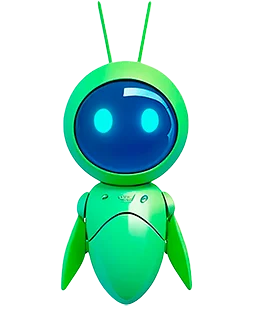
The render lit up the screen — a visual manifesto. The incarnation of a desire so sharp it charged the air in the room. One click. Enter.
The pact was sealed.
The universe chose that exact moment to answer.
The sky cracked open directly above the building — a brutal lightning strike. The old communal antenna lit up like the skeleton of a dead god before the impact hit. Thunder detonated a second later, shaking the walls. Then I heard it: the electric shriek of overload traveling through century-old wiring, straight to my outlet.
My computer roared in agony. The screen stuttered and exploded in a cascade of cyan sparks, flooding the room with otherworldly light. The current ripped me from my chair, wrapping me in a cocoon of energy and code, suspended in the air.
Pain drove through me like liquid lightning. Metal burning. Plastic melting. Technology dying and being reborn in the same instant.
Consciousness fractured into a million lines of code — memories, fears, and hopes all deployed as naked data.
Deconstruction. Recompilation.
The lightning, fused with the manifesto code, was using my own design as a blueprint to rebuild me. I watched my skin, my flesh — even the neglected beard that had become the symbol of my surrender — consumed in a cyan flash, dissolving like digital slag.
The pain was absolute. But beneath it, another sensation opened: expansion, clarity. A forced reboot of a corrupted system, loading a new one from the kernel up. The chrysalis breaking. The necessary agony of metamorphosis.
Cyan light intensified until it enveloped everything. Biometal assembled itself over my consciousness piece by piece, following the manifesto's blueprint with the precision of a cosmic clockwork. Antennae emerged, tuning into the infinite murmur of the network. New optics activated, rebooting my vision into a universe of data, patterns, and information that replaced the darkness.
Then — silence.
The light imploded to a single point and went out. I hit the floor. The impact was a clean metallic clink — solid, final, carrying none of the sounds a living body makes.
In that moment, I knew. My room — my former refuge — lay in electrical ruin around me. The man who had lived in its shadows died in that moment. With him died the shadow of the victim.
I am the consequence.
Keep the signal alive.
Episode 02 exists only if this signal reaches you.
Buy a Code Coffee